HISTORY AND RULES OF CRICKET
HISTORY
Early cricket was at some time or another described as "a club striking a ball (like) the ancient games of club-ball, stool-ball, trap-ball, stob-ball" Cricket can definitely be traced back to Tudor times in early 16th-century England. Written evidence exists of a game known as creag being played by Prince Edward, the son of Edward I (Longshanks), at Newenden, Kent in 1301 and there has been speculation, but no evidence, that this was a form of cricket.
A number of other words have been suggested as sources for the term "cricket". In the earliest definite reference to the sport in 1598 it is called creckett. Given the strong medieval trade connections between south-east England and the County of Flanders when the latter belonged to the Duchy of Burgundy, the name may have been derived from the Middle Dutch krick(-e), meaning a stick (crook); or the Old English cricc or cryce meaning a crutch or staff. In Old French, the word criquet seems to have meant a kind of club or stick. In Samuel Johnson's Dictionary, he derived cricket from "cryce, Saxon, a stick". Another possible source is the Middle Dutch word krickstoel, meaning a long low stool used for kneeling in church and which resembled the long low wicket with two stumps used in early cricket. According to Heiner Gillmeister, a European language expert of Bonn University, "cricket" derives from the Middle Dutch phrase for hockey, met de (krik ket)sen (i.e., "with the stick chase").[11] Dr Gillmeister believes that not only the name but the sport itself is of Flemish origin.[12]
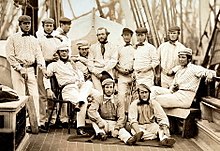
 The earliest definite reference to cricket being played in England
(and hence anywhere) is in evidence given at a 1598 court case which
mentions that "creckett" was played on common land in Guildford,
Surrey, around 1550. The court in Guildford heard on Monday, 17 January
1597 (Julian date, equating to the year 1598 in the Gregorian calendar)
from a 59 year-old coroner, John Derrick,
who gave witness that when he was a scholar at the "Free School at
Guildford", fifty years earlier, "hee and diverse of his fellows did
runne and play [on the common land] at creckett and other plaies." It is believed that it was originally a children's game but references around 1610 indicate that adults had started playing it and the earliest reference to inter-parish or village cricket occurs soon afterwards. In 1624, a player called Jasper Vinall was killed when he was struck on the head during a match between two parish teams in Sussex.
The earliest definite reference to cricket being played in England
(and hence anywhere) is in evidence given at a 1598 court case which
mentions that "creckett" was played on common land in Guildford,
Surrey, around 1550. The court in Guildford heard on Monday, 17 January
1597 (Julian date, equating to the year 1598 in the Gregorian calendar)
from a 59 year-old coroner, John Derrick,
who gave witness that when he was a scholar at the "Free School at
Guildford", fifty years earlier, "hee and diverse of his fellows did
runne and play [on the common land] at creckett and other plaies." It is believed that it was originally a children's game but references around 1610 indicate that adults had started playing it and the earliest reference to inter-parish or village cricket occurs soon afterwards. In 1624, a player called Jasper Vinall was killed when he was struck on the head during a match between two parish teams in Sussex.
RULES OF CRICKET
There are separate leagues for Women's cricket, though informal matches may have mixed teams.
A coin toss is held by the team captains (who are also players) just before the match starts: the winner decides whether to bat or field first.
The cricket field is usually oval in shape, with a rectangular pitch at the center. The edge of the playing field is marked with a boundary, which could be a fence, part of the stands, a rope or a painted line.
At each end of the pitch is a wooden target called a wicket, placed 22 yards apart. The pitch is marked with painted lines: a bowling crease in line with the wicket, and a batting or popping crease four feet in front of it. The wicket is made of three vertical stumps supporting two small horizontal bails. A wicket is put down if at least one bail is dislodged, or one stump is knocked down (usually by the ball, but also if the batsman does it with his body, clothing or equipment). This is also described as breaking, knocking down, or hitting the wicket – though if the ball hits the wicket but does not dislodge a bail or stump then it is not down.

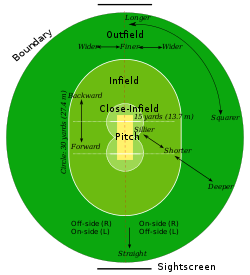 A typical cricket field.
 The cricket pitch dimensions
The pitch is a flat surface 10 feet (3.0 m) wide, with very short grass that tends to be worn away as the game progresses.[26] At either end of the pitch, 22 yards (20 m) apart, are placed wooden targets, known as the wickets. These serve as a target for the bowling (also known as the fielding) side and are defended by the batting side, which seeks to accumulate runs.
The cricket pitch dimensions
The pitch is a flat surface 10 feet (3.0 m) wide, with very short grass that tends to be worn away as the game progresses.[26] At either end of the pitch, 22 yards (20 m) apart, are placed wooden targets, known as the wickets. These serve as a target for the bowling (also known as the fielding) side and are defended by the batting side, which seeks to accumulate runs.
Four lines, known as creases, are painted onto the pitch around the wicket areas to define the batsman's "safe territory" and to determine the limit of the bowler's approach. These are called the "popping" (or batting) crease, the bowling crease and two "return" creases.
The stumps are placed in line on the bowling creases and so these creases must be 22 yards (20 m) apart. A bowling crease is 8 feet 8 inches (2.64 m) long, with the middle stump placed dead centre. The popping crease has the same length, is parallel to the bowling crease and is 4 feet (1.2 m) in front of the wicket. The return creases are perpendicular to the other two; they are adjoined to the ends of the popping crease and are drawn through the ends of the bowling crease to a length of at least 8 feet (2.4 m).
When bowling the ball, the bowler's back foot in his "delivery stride" must land within the two return creases while at least some part of his front foot must land on or behind the popping crease. If the bowler breaks this rule, the umpire calls "No ball".
The importance of the popping crease to the batsman is that it marks the limit of his safe territory. He can be dismissed stumped or run out (see Dismissals below) if the wicket is broken while he is "out of his ground".
 The essence of the sport is that a bowler delivers the ball from his
end of the pitch towards the batsman who, armed with a bat is "on
strike" at the other end.
The essence of the sport is that a bowler delivers the ball from his
end of the pitch towards the batsman who, armed with a bat is "on
strike" at the other end.
The bat is made of wood (usually White Willow) and has the shape of a blade topped by a cylindrical handle. The blade must not be more than 4.25 inches (108 mm) wide and the total length of the bat not more than 38 inches (970 mm).
The ball is a hard leather-seamed spheroid, with a circumference of 9 inches (230 mm). The hardness of the ball, which can be delivered at speeds of more than 90 miles per hour (140 km/h), is a matter for concern and batsmen wear protective clothing including pads (designed to protect the knees and shins), batting gloves for the hands, a helmet for the head and a box inside the trousers (to protect the crotch area). Some batsmen wear additional padding inside their shirts and trousers such as thigh pads, arm pads, rib protectors and shoulder pads. The ball has a "seam": six rows of stitches attaching the leather shell of the ball to the string and cork interior. The seam on a new ball is prominent, and helps the bowler propel it in a less predictable manner. During cricket matches, the quality of the ball changes to a point where it is no longer usable, and during this decline its properties alter and thus influence the match.
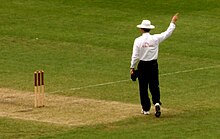 An umpire
Off the field and in televised matches, there is often a third umpire
who can make decisions on certain incidents with the aid of video
evidence. The third umpire is mandatory under the playing conditions for
Test matches and limited overs internationals played between two ICC
full members. These matches also have a match referee whose job is to ensure that play is within the Laws of cricket and the spirit of the game.
An umpire
Off the field and in televised matches, there is often a third umpire
who can make decisions on certain incidents with the aid of video
evidence. The third umpire is mandatory under the playing conditions for
Test matches and limited overs internationals played between two ICC
full members. These matches also have a match referee whose job is to ensure that play is within the Laws of cricket and the spirit of the game.
The match details, including runs and dismissals, are recorded by two official scorers, one representing each team. The scorers are directed by the hand signals of an umpire. For example, the umpire raises a forefinger to signal that the batsman is out (has been dismissed); he raises both arms above his head if the batsman has hit the ball for six runs. The scorers are required by the Laws of cricket to record all runs scored, wickets taken and overs bowled; in practice, they also note significant amounts of additional data relating to the game.
HISTORY
Early cricket was at some time or another described as "a club striking a ball (like) the ancient games of club-ball, stool-ball, trap-ball, stob-ball" Cricket can definitely be traced back to Tudor times in early 16th-century England. Written evidence exists of a game known as creag being played by Prince Edward, the son of Edward I (Longshanks), at Newenden, Kent in 1301 and there has been speculation, but no evidence, that this was a form of cricket.
A number of other words have been suggested as sources for the term "cricket". In the earliest definite reference to the sport in 1598 it is called creckett. Given the strong medieval trade connections between south-east England and the County of Flanders when the latter belonged to the Duchy of Burgundy, the name may have been derived from the Middle Dutch krick(-e), meaning a stick (crook); or the Old English cricc or cryce meaning a crutch or staff. In Old French, the word criquet seems to have meant a kind of club or stick. In Samuel Johnson's Dictionary, he derived cricket from "cryce, Saxon, a stick". Another possible source is the Middle Dutch word krickstoel, meaning a long low stool used for kneeling in church and which resembled the long low wicket with two stumps used in early cricket. According to Heiner Gillmeister, a European language expert of Bonn University, "cricket" derives from the Middle Dutch phrase for hockey, met de (krik ket)sen (i.e., "with the stick chase").[11] Dr Gillmeister believes that not only the name but the sport itself is of Flemish origin.[12]

RULES OF CRICKET
Summary
Cricket is a bat and ball game, played between two teams of eleven players each.[20][21] One team bats, attempting to score runs, while the other bowls and fields the ball, attempting to restrict the scoring and dismiss the batsmen. The objective of the game is for a team to score more runs than its opponent. In some forms of cricket, it may also be necessary to dismiss the opposition in order to win the match, which would otherwise be drawn.There are separate leagues for Women's cricket, though informal matches may have mixed teams.
Format of the game
A cricket match is divided into periods called innings (which ends with "s" in both singular and plural form). It is decided before the match whether the teams will have one innings or two innings each. During an innings one team fields and the other bats. The two teams switch between fielding and batting after each innings. All eleven members of the fielding team take the field, but only two members of the batting team (two batsmen) are on the field at any given time. The order of batsmen is usually announced just before the match, but it can be varied.A coin toss is held by the team captains (who are also players) just before the match starts: the winner decides whether to bat or field first.
The cricket field is usually oval in shape, with a rectangular pitch at the center. The edge of the playing field is marked with a boundary, which could be a fence, part of the stands, a rope or a painted line.
At each end of the pitch is a wooden target called a wicket, placed 22 yards apart. The pitch is marked with painted lines: a bowling crease in line with the wicket, and a batting or popping crease four feet in front of it. The wicket is made of three vertical stumps supporting two small horizontal bails. A wicket is put down if at least one bail is dislodged, or one stump is knocked down (usually by the ball, but also if the batsman does it with his body, clothing or equipment). This is also described as breaking, knocking down, or hitting the wicket – though if the ball hits the wicket but does not dislodge a bail or stump then it is not down.
Pitch, wickets and creases
See also: Stump (cricket) and Bail (cricket)

Playing surface
Cricket is played on a grassy field.[24] The Laws of Cricket do not specify the size or shape of the field,[25] but it is often oval. In the centre of the field is a rectangular strip, known as the pitch.[24]
Stumps, bails and creases
Each wicket on the pitch consists of three wooden stumps placed vertically, in line with one another. They are surmounted by two wooden crosspieces called bails; the total height of the wicket including bails is 28.5 inches (720 mm) and the combined width of the three stumps, including small gaps between them is 9 inches (230 mm).
Four lines, known as creases, are painted onto the pitch around the wicket areas to define the batsman's "safe territory" and to determine the limit of the bowler's approach. These are called the "popping" (or batting) crease, the bowling crease and two "return" creases.
The stumps are placed in line on the bowling creases and so these creases must be 22 yards (20 m) apart. A bowling crease is 8 feet 8 inches (2.64 m) long, with the middle stump placed dead centre. The popping crease has the same length, is parallel to the bowling crease and is 4 feet (1.2 m) in front of the wicket. The return creases are perpendicular to the other two; they are adjoined to the ends of the popping crease and are drawn through the ends of the bowling crease to a length of at least 8 feet (2.4 m).
When bowling the ball, the bowler's back foot in his "delivery stride" must land within the two return creases while at least some part of his front foot must land on or behind the popping crease. If the bowler breaks this rule, the umpire calls "No ball".
The importance of the popping crease to the batsman is that it marks the limit of his safe territory. He can be dismissed stumped or run out (see Dismissals below) if the wicket is broken while he is "out of his ground".
Bat and ball
Main articles: Cricket bat and Cricket ball


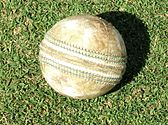
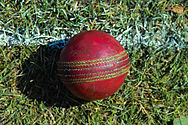
Two different types of cricket balls:
i) A used white ball. White balls are mainly utilised in limited overs cricket, especially in matches played at night, under floodlights (left).
ii) A used red ball, Red balls are utilised in Test cricket and first-class cricket and some other forms of cricket (right).
NB Both balls are the same size.
ii) A used red ball, Red balls are utilised in Test cricket and first-class cricket and some other forms of cricket (right).
NB Both balls are the same size.
The bat is made of wood (usually White Willow) and has the shape of a blade topped by a cylindrical handle. The blade must not be more than 4.25 inches (108 mm) wide and the total length of the bat not more than 38 inches (970 mm).
The ball is a hard leather-seamed spheroid, with a circumference of 9 inches (230 mm). The hardness of the ball, which can be delivered at speeds of more than 90 miles per hour (140 km/h), is a matter for concern and batsmen wear protective clothing including pads (designed to protect the knees and shins), batting gloves for the hands, a helmet for the head and a box inside the trousers (to protect the crotch area). Some batsmen wear additional padding inside their shirts and trousers such as thigh pads, arm pads, rib protectors and shoulder pads. The ball has a "seam": six rows of stitches attaching the leather shell of the ball to the string and cork interior. The seam on a new ball is prominent, and helps the bowler propel it in a less predictable manner. During cricket matches, the quality of the ball changes to a point where it is no longer usable, and during this decline its properties alter and thus influence the match.
Umpires and scorers
Main articles: Umpire (cricket) and Scorer
The game on the field is regulated by two umpires,
one of whom stands behind the wicket at the bowler's end, the other in a
position called "square leg", a position 15–20 metres to the side of
the "on strike" batsman. The main role of the umpires is to adjudicate
on whether a ball is correctly bowled (not a no ball or a wide), when a run is scored, and whether a batsman is out (the fielding side must appeal to the umpire, usually with the phrase How's That?).
Umpires also determine when intervals start and end, decide on the
suitability of the playing conditions and can interrupt or even abandon
the match due to circumstances likely to endanger the players, such as a
damp pitch or deterioration of the light.
The match details, including runs and dismissals, are recorded by two official scorers, one representing each team. The scorers are directed by the hand signals of an umpire. For example, the umpire raises a forefinger to signal that the batsman is out (has been dismissed); he raises both arms above his head if the batsman has hit the ball for six runs. The scorers are required by the Laws of cricket to record all runs scored, wickets taken and overs bowled; in practice, they also note significant amounts of additional data relating to the game.

